
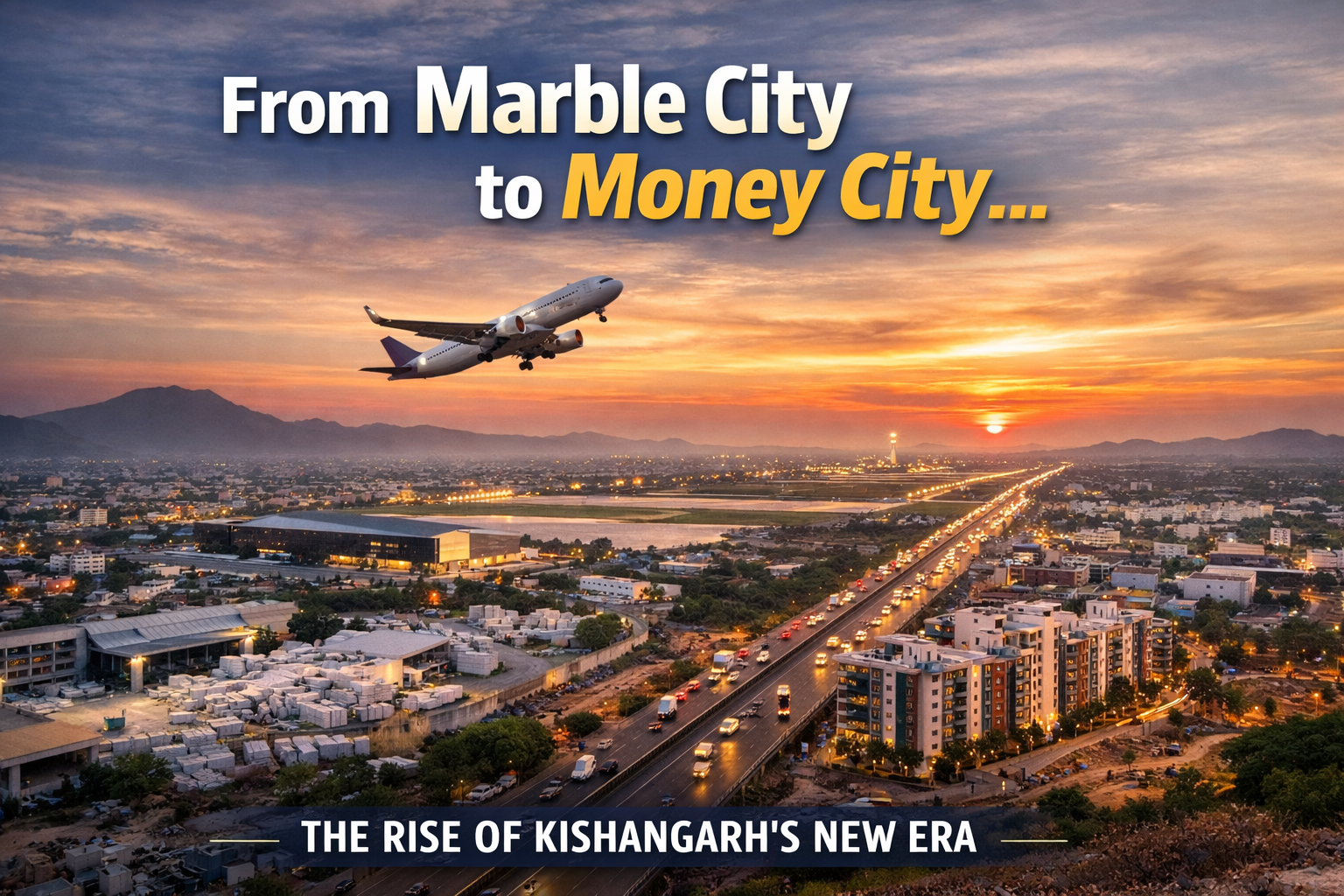
Kishangarh Real Estate Growth | From Marble City to Money City
In Rajasthan’s evolving urban landscape, certain cities are beginning to stand out—not because of hype, but because of structural transformation. One such city is Kishangarh, which is gradually transitioning from its traditional identity into a modern economic and real estate growth center.
This shift is not accidental. It is driven by a combination of industrial strength, infrastructure expansion, and planned urban development—three pillars that historically define sustainable real estate growth.
🏗️ A Strong Industrial Backbone Creating Real Demand
Unlike many emerging markets that rely heavily on speculative interest, Kishangarh benefits from an already established industrial ecosystem.
Known globally for its marble and stone industry, the region hosts one of the largest trading and processing hubs in Asia. Thousands of traders, exporters, and workers operate within this ecosystem, creating a continuous cycle of economic activity.
This has a direct impact on real estate:
- Demand is driven by actual users, not just investors
- Workforce expansion fuels residential requirements
- Commercial and logistics spaces grow alongside industrial activity
In simple terms, the demand here is organic—and that makes a significant difference in long-term stability.
✈️ Infrastructure Development Acting as a Value Multiplier
Infrastructure has historically been the single most powerful driver of real estate appreciation—and Kishangarh is currently experiencing this effect in real time.
One of the most impactful developments has been the introduction and expansion of air connectivity. Improved access has significantly reduced travel friction, enabling smoother movement of business professionals, traders, and tourists.
This phenomenon—often referred to as the “airport effect”—has been observed across multiple Indian cities, where regions near operational airports tend to witness faster appreciation cycles.
Beyond aviation, road infrastructure is also undergoing rapid enhancement:
- Expansion of major highways
- Development of high-speed corridors
- Reduced travel time to key cities
Such connectivity upgrades do more than improve travel—they integrate the city into larger economic networks.
🛣️ Strategic Location Within Larger Economic Corridors
Kishangarh’s positioning adds another layer of advantage.
It lies within the influence zone of major industrial and freight corridors, connecting it to large-scale national economic initiatives. This ensures:
- Increased industrial inflow
- Growth in logistics and warehousing demand
- Long-term economic relevance
When a city becomes part of a broader economic corridor, its growth is no longer isolated—it becomes systemic.
🏙️ Planned Urban Expansion, Not Random Growth
One of the key differentiators in Kishangarh’s growth story is the presence of structured urban planning.
Rather than unregulated expansion, development is being guided through a defined master plan that focuses on:
- Clear zoning of residential, commercial, and industrial areas
- Controlled expansion to avoid infrastructure strain
- Integration of social infrastructure like education and public services
This ensures that growth remains sustainable and organized, rather than chaotic—a critical factor for long-term livability and investment confidence.
🏡 Transition Toward a Residential Ecosystem
Historically dominated by industrial activity, the region is now witnessing a gradual shift toward becoming a residential hub as well.
This transition is driven by:
- Migration of professionals and business owners Increasing demand for quality housing Growth in rental markets
As employment opportunities expand, residential demand follows naturally. Over time, this leads to the development of a balanced urban ecosystem where people not only work—but also live and settle.
⚠️ A Balanced Perspective: Opportunity with Awareness
While the growth indicators are strong, it is important to approach such markets with clarity rather than excitement alone.
Key considerations include:
- Evaluating locations based on infrastructure proximity
- Ensuring legal and regulatory compliance
- Avoiding purely speculative decisions
Sustainable gains in real estate are typically achieved through informed, long-term strategies rather than short-term trends.
🚀 Conclusion: A City in Transition
Kishangarh represents a classic example of infrastructure-led urban transformation.
With a strong industrial base, improving connectivity, and structured planning, the city is positioning itself as a significant node in Rajasthan’s future growth landscape.
The real question is no longer whether the city is growing—but how early one recognizes and understands that growth.