
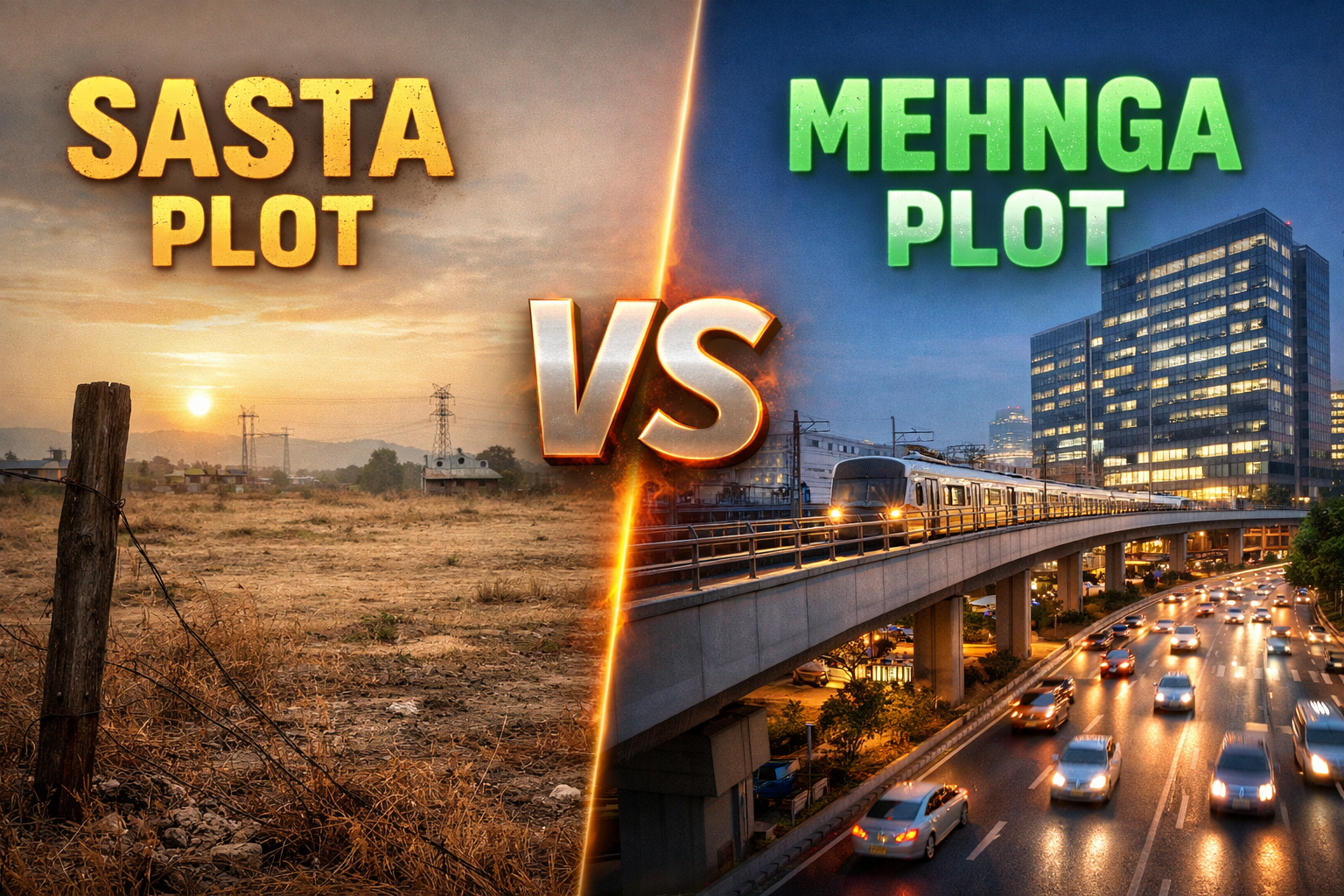
Cheap vs. Expensive: The Real Estate Paradox
In the world of investing, there is a famous saying: “Price is what you pay, value is what you get.” When it comes to land, the “cheapest” option is rarely the most profitable.
1. The Trap of the “Rate Shopper”
Most amateur investors focus solely on the entry price. They look for the lowest rate in the market, thinking they are getting a “steal.” However, land is usually cheap for a reason:
-
Lack of Infrastructure: No roads, water, or electricity.
-
Legal Ambiguity: Dubious titles or disputed ownership.
-
Zero Velocity: No one wants to live or do business there, meaning no resale value.
-
The “Dead Zone”: A plot that costs 1,000 per sq. ft. but stays at that price for 10 years is actually a loss due to inflation.
2. The Strategy of the “Smart Investor”
A smart investor doesn’t ask “How much is it?” as their first question. Instead, they ask, “What is the catalyst for growth?” They are willing to pay a premium (the “expensive” plot) if the fundamentals are strong.
| Feature | The “Cheap” Plot (Rate-Focused) | The “Expensive” Plot (Value-Focused) |
| Location | Remote, outskirts, no connectivity. | Near upcoming hubs, highways, or airports. |
| Growth Drivers | Hope and rumors. | Government projects, MNCs, or schools. |
| Liquidity | Hard to sell; no buyers. | High demand; can be sold quickly. |
| Rental Potential | Near zero. | High potential for commercial/residential. |
| Real Return | Often lower than inflation. | Compounded growth (Wealth Creation). |
Why “Expensive” is Often the Better Bargain
Imagine two plots:
-
Plot A (Sasta): Costs ₹10 Lakhs in a barren area. In 5 years, it might become ₹12 Lakhs. Your profit is small, and your money was locked away.
-
Plot B (Mehnga): Costs ₹30 Lakhs in a developing corridor. Because a new metro station and a tech park are being built nearby, it doubles to ₹60 Lakhs in 5 years.
The Lesson: The “expensive” plot gave you a 100% return, while the “cheap” plot barely covered your taxes. Smart investors look for Alpha—the extra return that comes from strategic positioning.
The “Cost of Waiting” vs. The “Cost of Entry”
People who only look at the rate often say, “I’ll wait for the prices to drop.” In real estate, prime land rarely gets cheaper; it only gets more inaccessible.
Smart investors understand that a high entry price is a filter. It keeps the “noise” out and ensures the neighborhood maintains a certain standard, which in turn drives up the future valuation.